Looking at the Mind-Blowing World of the Kombucha Scoby
If you’ve delved into the fantastic world of kombucha, you’ve likely come across the term “SCOBY.” But what exactly is a SCOBY, and why is it such a crucial element in the fermentation process of kombucha? In this article, we’ll explore the fascinating world of the kombucha SCOBY, its role in brewing this probiotic-rich beverage, and how to care for it.
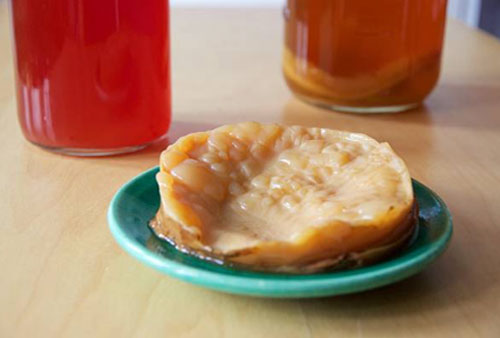
SCOBY is an acronym for “Symbiotic Culture of Bacteria and Yeast.” It’s often referred to as the “kombucha mother” or “kombucha mushroom,” although it is not a mushroom at all. Instead, the SCOBY is a rubbery, jelly-like disc that forms on the surface of the sweetened tea during the fermentation process. This living organism is responsible for the transformation of the sweet tea into tangy and fizzy kombucha.
The SCOBY consists of a complex community of microorganisms, including various strains of bacteria (such as Acetobacter, Gluconacetobacter, and Lactobacillus) and yeast (such as Saccharomyces, Brettanomyces, and Candida). These microorganisms work together symbiotically, with each playing a specific role in the fermentation process.
The bacteria in the SCOBY metabolize the alcohol produced by yeast, converting it into acetic acid. This process gives kombucha its characteristic tanginess. The yeast, on the other hand, consumes the sugar in the sweetened tea, producing alcohol and carbon dioxide. The carbon dioxide is responsible for the natural carbonation found in kombucha.
To brew kombucha, you need a SCOBY as a starting point. You can obtain a SCOBY from a friend who brews kombucha or purchase one online or from a local store. It’s important to ensure that your SCOBY is healthy and free from any signs of mold or contamination. A healthy SCOBY should be firm, off-white to beige in color, and free from black spots or unusual growths.
Caring for your SCOBY is crucial to maintaining a successful and consistent brewing process. Here are some tips for SCOBY care:
Storage:
First, if you’re not using your SCOBY immediately, store it in a glass jar with enough kombucha liquid to cover it. Seal the jar with a breathable cloth or coffee filter secured with a rubber band. Keep it at room temperature away from direct sunlight.
Feeding:
Second, your SCOBY needs a continuous supply of nutrients to thrive. Regularly feed it by brewing batches of sweetened tea for fermentation. The SCOBY will consume the sugar and tea, producing kombucha in the process.
Hygiene:
Third, maintain good hygiene practices when handling your SCOBY and brewing equipment. Use clean utensils and wash your hands thoroughly before touching the SCOBY or preparing the tea. Avoid cross-contamination with other substances that may harm the SCOBY.
Temperature:
Fourth, the SCOBY prefers a temperature range of 68°F to 78°F (20°C to 26°C) for optimal fermentation. Extreme temperatures can stress or damage the SCOBY, affecting the quality of the kombucha.
SCOBY Hotel:
Fifth and equally important is if you have multiple SCOBYs or want to take a break from brewing, you can create a SCOBY hotel. Place extra SCOBYs in a jar with enough kombucha liquid to cover them and store them as mentioned in the storage tip.
Finally, remember that your SCOBY will naturally grow and reproduce over time. With each batch of kombucha, your SCOBY may produce a new layer on top, which can be used to start another brewing cycle or shared with others who are interested in brewing their own kombucha.